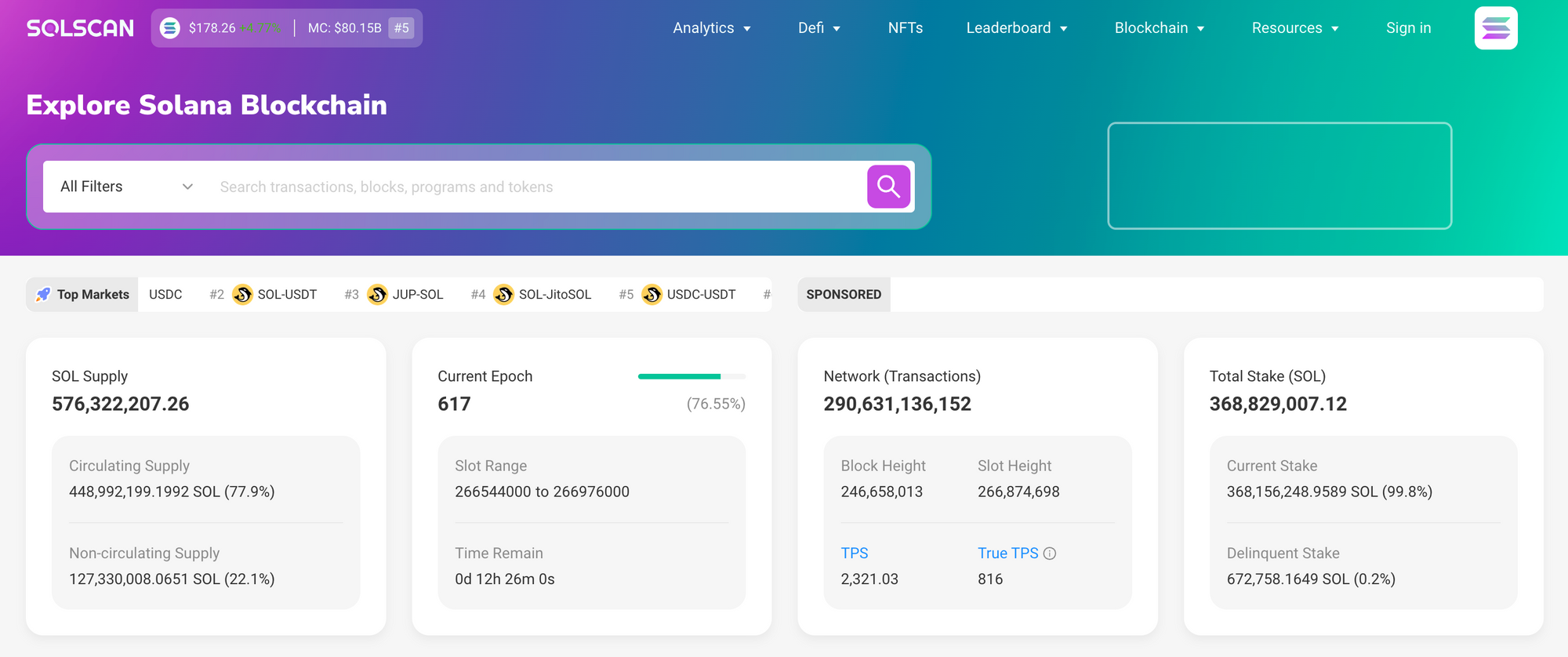
Why Solana Analytics Matter: A Practical Guide to Token Tracking with Solscan

Okay, so check this out—Solana moves fast. Really fast. Wow! If you blink, a block’s gone and a token swap has already settled. My instinct said that conventional explorers would feel clunky here; and yeah, they often do.

At first glance the tools look familiar. But they’re optimized differently. Initially I thought blockchain explorers were interchangeable across chains, but then I noticed the latency patterns and UX choices that are Solana-specific. Actually, wait—let me rephrase that: Solana demands low-latency interfaces and concise token views, and not every explorer respects that need.

Here’s what bugs me about generic analytics dashboards. They try to do everything and end up doing a few things poorly. On one hand you want deep on-chain context; though actually, too much noise hides the signals you need. Hmm… somethin’ like that—too many charts, not enough clarity.

So what do you need when you’re tracking tokens on Solana? You need transaction timelines, token holder distributions, program interactions, mint history, and quick drills for rug-checks. Seriously? Yes. Fast, readable, and reliable—those are the priorities that end up saving you money and time.
Screenshot-style illustration of a token dashboard with transaction list and holder distribution

How to make analytics useful, not overwhelming

Start with the basics. Look at the mint date and initial distribution. Check ownership concentration. Check recent large transfers. Whoa! Pause when you see clustered whales moving in days before an airdrop or price pump. My experience: patterns often repeat across projects, and early signs—big token transfers, program upgrades, or sudden change in liquidity pools—are red flags worth investigating.

What I do, step by step, is simple and repeatable. First, open the token page. Next, scan the top holders list for concentration. Then, open the latest 20 transactions and filter by program or memos. This triage helps me spot normal market activity versus coordinated moves. I’m biased, but it’s saved me from very very messy trades more than once.

Okay—here’s a practical tip. When you see a transfer to a mysterious wallet followed by rapid dispersal to many wallets, suspect swapping bots or wash trading. On the other hand, transfers into known exchange addresses usually mean liquidity or listing moves. Not always, but often.

For day-to-day monitoring I prefer tools that combine raw on-chain data with readable visual cues. That’s why I use solscan as a routine reference; the interface gives quick access to token mint info, transfer logs, and program activity without hunting through nested menus. The link I rely on is solscan.

There’s nuance though. Program-level interactions in Solana can be subtle. A token can be wrapped, frozen, or delegated by a program call, and if you miss that, your risk assessment is incomplete. So I scan the instructions behind major transactions—this is where the meat is.

Let me be honest: the learning curve felt steep at first. I once misread a memo and assumed liquidity was locked when it wasn’t. Oof. That cost me sleep. But those errors teach you what to lock into your checklist.

Key Solana-specific signals to watch

Program upgrades. Short sentence. When a program that manages a token is upgraded or re-assigned, the rules of the game can change—sometimes trivially, sometimes drastically. My read of on-chain activity now always includes checking for recent program authority changes.

Mint anomalies. Medium length here for clarity. Unexpected additional mints, or mints to obscure addresses, are immediate red flags for inflation risk. Monitor the mint authority and its activity over time. If it shows up active after a long dormancy, alert bells should ring.

Liquidity shifts. Longer explanation because there’s more to unpack: watch for sudden withdrawals from concentrated LP pools or transfers into bridging contracts where tokens might be wrapped and moved off-chain, since those actions affect on-exchange depth and price vulnerability, especially on thinly traded pairs with low TVL.

Taxonomy of holders. Short. What percentage of supply sits in top 10 wallets? Medium. Less than 10% concentration is healthier, though it depends on the token’s purpose and staking model. Long: a token heavily held by a few wallets is susceptible to dump risk or coordinated price manipulation, and you should model potential outcomes for selling pressure in your head (or in a spreadsheet) before committing capital.

Timing matters. Trades that cluster right after token unlocks or announcements are suspect. Track the timeline of governance votes and vesting schedules to correlate on-chain moves with expected liquidity events.

Common questions I get

How do I verify a token’s legitimacy quickly?

Start with the token mint and holder distribution. Check for program authority activity and recent mints. Scan recent transactions for memos or interaction with known bridge or exchange addresses. If many tokens move through short-lived wallets or mixing patterns, step back. Seriously—if somethin’ feels off, it probably is.

Can analytics prevent every scam?

No. Short answer. Analytics reduce odds and help prioritize checks. You still need complementary signals: community chatter, audits (if any), verified project accounts, and off-chain promises. On one hand, analytics expose many scams early; though actually, social engineering and rug exits still trip up even seasoned users.

Final note—this field evolves. Tools improve, program patterns change, and bridge mechanics shift. I’m not 100% sure about every emerging exploit, but I try to keep the checklist adaptable. If you build rituals around mint checks, holder scans, and instruction-level reviews, you’ll be in a much better spot. Trailing thought… stay curious, and don’t trust first impressions blindly.


Picking the Right Solana Validator: A Practical Guide to Rewards, Risk, and Rewards That Actually Matter

Started mid-thought — because that’s how this topic usually hits me when I open my wallet. Wow! Choosing a validator on Solana feels simple until you actually look under the hood. Most folks see an APY number and stop. My instinct said there was more to it. Seriously? Yep. There’s more — and some of it matters a lot.

Quick reality check. Staking on Solana is not just “lock and forget.” True, you delegate your SOL and earn staking rewards, but the compounding effects, validator performance, and fees shape your yield. On one hand, the nominal reward rate is attractive. On the other hand, downtime and high commission can erode those gains. Initially I thought picking the highest APR was the smart move, but then I noticed validators with shiny rates missing blocks during network congestion — ouch. Actually, wait — let me rephrase that: reliability beats tiny differences in commission for most retail stakers.

Here’s the thing. Validators are the backbone of Solana’s fast finality. They sign blocks, secure the ledger, and handle stake. Hmm… there’s a trade-off. You can stake with a big well-known validator (safe-ish) or take a punt on a newer operator with lower fees. My gut says diversify a bit. But don’t go crazy. A single risky validator failure can cost you more than the extra 0.5% commission you hoped to save.

Solana validator network illustration with nodes and staking lines

What to look for — beyond APR

First, check performance metrics. Uptime and vote account performance are crucial. Short sentence. Look for consistent on-time voting; missed votes mean missed rewards. Transparency matters too — operators who publish infra details (locations, redundancy, monitoring) usually care more about long-term reliability. Also watch commission rates and how often they change. Some validators advertise low fees but raise them later when they have large stake — that bugs me. I’m biased toward validators that explain fee models clearly.

Second, consider decentralization impact. Delegating to mega-validators concentrates power. On one hand, delegating to a popular validator may feel safe because of proven uptime. Though actually, if too many people pile into the same few validators, the network’s resilience weakens. So I usually split stake across two or three good validators — a practical balance between simplicity and decentralization. Something felt off about delegating everything to the biggest name, and that’s not just FUD.

Third, community and governance. Validators that engage with the community, support open-source tooling, or run initiatives (like stake matching or education) tend to be more trustworthy. They’re often the ones who respond fast during network upgrades or incidents. And yes — sometimes validators are aligned with projects that matter to you, like NFT marketplaces on Solana or DeFi protocols, which can be convenient.

Validator rewards: how they actually work

Rewards on Solana are distributed based on stake weighting and performance. Short. The network mints inflationary rewards and allocates them to validators proportional to active stake and voting accuracy. Validators then take a commission and pass the remainder to delegators. Compounding frequency depends on your wallet — daily or epoch-based payouts are common. My inner nerd loves the math here, though I’ll be honest: the math gets fuzzy with slashing risk, commission changes, and stake activation delays.

Activation delay is a big practical item. When you delegate, your stake doesn’t earn immediately — there is an activation process tied to epochs. That means timing matters around network events and upgrades. Also, unstaking isn’t instant either: you pass through deactivation and wait for epochs to close before funds are fully liquid. That has bitten traders who assumed they could free up SOL the same day.

Commission structure varies. Some validators charge 0% initially to attract stake, then move to 5-10% later. Others keep steady commissions but offer extra perks like airdrops or analytics. How important are perks? Depends on you. For long-term passive holders, stable commission and high uptime win. For active NFT flippers, faster access and low fees might be higher priority.

Choosing a wallet extension that supports staking and NFTs

Okay, so you know what to look for in a validator. Next: choose the right wallet to delegate from. Wallet UX matters. You want clear delegation flows, transparent commission reporting, and NFT support so your collectibles don’t get lost in some separate app. Check the extension’s reputation and features. Also check security practices — seed phrase handling, permissions, and open-source code if available. I’m partial to tools that let me view validators, compare metrics, and switch delegates without fuss.

For folks who prefer a browser extension, there’s a solid option worth trying out — it’s simple, supports staking, and handles NFTs in the same place: https://sites.google.com/solflare-wallet.com/solflare-wallet-extension/ . Seriously, it’s clean, and I’ve used similar flows when juggling stake across a couple of validators. (oh, and by the way… check extension permissions before you approve anything.)

Security aside, UX friction is real. If the wallet makes delegation a multi-step, confusing process, you might avoid staking entirely — and that’s a real cost. So choose one that fits your comfort level: some people want one-click stake, others want full control and advanced options.

Practical checklist before delegating

1) Check validator uptime and missed vote history. Short. 2) Confirm commission and recent changes. 3) Review the validator’s community presence and transparency. 4) Ensure your wallet supports easy delegation and NFT access. 5) Consider splitting stake between validators to balance risk and decentralization. 6) Remember activation and deactivation timings.

Don’t ignore slashing — it’s rare on Solana, but misconfigurations and double-signing can happen. If a validator behaves maliciously or is compromised, you could lose stake, though the mechanisms are not as punitive as some chains. On the flip side, validators with great uptime but opaque operations are also red flags. There’s no perfect heuristic; mix metrics with a little judgment.

Common questions (FAQ)

How much SOL should I stake to start?

Start small if you’re testing — maybe a handful of SOL — and observe rewards and activation times. Short. You can always add more later. If you’re staking long-term, aim to diversify across two validators rather than concentrate everything in one place.

Will staking prevent me from trading quickly?

Yes and no. Unstaking requires epoch transitions which can take time, so if you need instant liquidity, keep a portion of your holdings unstaked. Seriously, plan around your cash flow needs. On one hand you want yields; on the other hand, markets can move fast.

Can validators steal my funds?

No. Delegation only assigns your vote power; you keep control of your keys and funds. But validators can misbehave in ways that reduce rewards or (in extreme cases) lead to slashing. So protect your seed phrase and delegate to trustworthy operators. I’m not 100% sure about hypothetical edge cases, but that’s the gist.

To wrap without sounding like a textbook: staking on Solana is practical and worth doing, but it’s not autopilot. Wow! Do your homework, pick validators that combine uptime, transparency, and reasonable fees, and choose a wallet extension that makes staking and NFT management straightforward. My take? Reliability and clear communication beat marginally higher APRs almost every time. Somethin’ to live by, maybe.

CFDs, algorithms, and the trading software that actually helps you win

Wow!

I got pulled into CFDs years ago and somethin’ about them stuck with me.

They give retail traders a way to express directional views and hedge exposures without juggling the underlying instrument itself.

Initially I thought CFDs were mainly for quick speculators, but after tracking execution, slippage, and margin behavior across dozens of brokers I realized they’re also powerful portfolio tools when paired with disciplined risk rules and reliable software that doesn’t lie to you about fills—so it’s not just “betting,” it’s engineering risk and exposure thoughtfully.

Here’s the thing.

Whoa!

Algorithmic trading rewired how I approach setups because it forces clarity: define an edge, size it, and test it out of sample.

Automating routine tasks kills revenge trading and those tiny intuitive overrides that cost you over time.

On one hand human judgment can catch regime shifts that a blind system misses, though actually, wait—let me rephrase that—blend both and you get a hybrid approach where discretion is used to tag regimes while automation enforces execution, and that balance is the part many traders miss.

My instinct said to keep strategy complexity low until the signal-to-noise is undeniable.

Okay, so check this out—

I ran scripts across MT4, MT5, and cTrader, and each one had tradeoffs in execution visibility and API quality.

What really matters isn’t bells and whistles; it’s order types, reporting on slippage, and the ability to backtest realistically at tick resolution.

When I dug into cTrader’s Automate environment and backtesting tools I found a clean workflow that lets you iterate fast, while still providing tick-level fidelity that surfaces microstructure problems—which is crucial if you’re trading CFDs on instruments with thin liquidity or high spreads.

I’m biased, but that part bugs me when platforms pretend their tick backtests are magic.

Screenshot mockup of a trading platform showing order fills, equity curve, and backtest metrics

Why platform choice matters — and where to get started

If you want somethin’ that balances usability with depth, check the ctrader download for a taste of a platform that puts execution transparency and algorithmic tools front and center.

Seriously? Yes—because the platform is the bridge between your strategy and live P&L, and if that bridge has holes you’ll see it in real money results.

Execution matters: latency, order routing, and how stop-losses behave in stressed markets change your realized edge.

On the other hand light-weight platforms can be great for discretionary setups, though in my experience active CFD traders outgrow them fast when they try to scale automation or multi-instrument correlation checks.

Something felt off about brokers that hide slippage stats; avoid those.

Hmm…

Data hygiene is a silent killer of strategies that look good on paper but fail in production.

Use clean, tick-level historical data where available, and always simulate realistic spreads and commission structures during backtests.

When you optimize blindly you get curve-fitting, and trust me—that’s the trap where every metric looks perfect until the live market sighs and laughs at your backtest assumptions.

Keep your parameter searches narrow and purpose-driven.

Whoa!

Position sizing is the part people skip because it’s mathy and reveals how fragile their system really is.

Risk per trade, portfolio risk, and worst-case drawdown scenarios should be documented before you go live.

On one hand you can use fixed fractional sizing to scale with equity, though actually there are times regime-dependent sizing rules or volatility targeting will materially reduce tail risk without killing returns—it’s a tradeoff and you should test both ways.

I’ll be honest: I’ve moved from fixed lots to volatility-adjusted sizing and it smoothed the P&L more than I hoped.

Okay, quick tangent (oh, and by the way…)

Latency arbitrage isn’t just for HFT firms; it affects stop fills and re-quotes in volatile CFD markets.

If your platform batches orders or uses poor routing, you will see slippage clusters that correlate with news and spikes.

When that happens you need both pre-trade controls and post-trade analytics to adjust your system or change broker/venue—doing nothing is the worst response.

Really? Yep, really.

Hmm…

Algorithmic robustness is tested by walk-forward analysis, Monte Carlo stress tests, and adversarial scenarios that mimic bad liquidity or fat tails.

Don’t rely on a single in-sample win; validate across multiple symbols, timeframes, and market conditions.

Initially I thought a long backtest on one pair would prove the idea, but then realized diversification across correlated instruments often uncovers hidden assumptions and behavioral biases in the strategy rules.

That realization changed how I vet systems forever.

Whoa!

Broker selection for CFDs is both compliance and performance: check margin policies, hedging rules, and how they handle negative balance protection.

Smaller spreads with higher slippage are sometimes worse than wider stable spreads; it’s the realized cost that counts.

On the whole, transparency beats marketing claims, though admittedly it’s tedious to dig through execution reports and request trade-by-trade fills—still, that’s the only way to be confident.

Something else to watch: counterparty risk and how a broker handles order congestion during market stress.

Okay, so here’s a practical checklist to bring this down to earth:

– Define the edge and test it at tick-level with realistic costs.

– Use walk-forward and Monte Carlo to understand variability.

– Implement disciplined sizing and pre-trade risk controls, and track slippage by hour and instrument.

– Automate execution where possible, but keep regime flags for discretionary intervention.

– Audit broker fills quarterly; don’t assume it’s fine.

FAQ

Are CFDs suitable for algorithmic trading?

Yes, CFDs are suitable, but they demand careful handling: you must account for leverage, spreads, and liquidity in your simulations, and ensure your execution platform supports the order types and reporting you need. My instinct said to start small and scale after several live months of consistent execution metrics, and that’s still the best advice—practice first, then scale.

How do I avoid overfitting my strategies?

Limit parameter freedom, use out-of-sample testing, apply walk-forward validation, and run Monte Carlo simulations that alter order of trades and slippage. Also check robustness by changing tick sizes or using different tick data vendors; if your system collapses, you probably tuned to noise rather than signal.

Private Blockchains and Privacy Coins: Why Monero Still Matters

Whoa! Privacy in crypto is messier than most people admit. Seriously? Yep — my gut said the same thing when I first dug in. Initially I thought privacy coins were a fringe curiosity, but then I saw how fundamental they are to financial freedom and personal dignity in a world that tracks everything. Okay, so check this out—this piece is for folks who care deeply about keeping their transaction history private, and who want a clear-eyed look at trade-offs without the hype.

Here’s the thing. Some blockchains are public ledgers where every transfer is a ledger entry anyone can read. Short sentence. That transparency is elegant and useful for many use cases. But it also means that every payment paints a picture of behavior that can be aggregated, analyzed, and sometimes weaponized by companies or states with the will to do so. On the other hand, privacy-focused protocols aim to break that easy linkability while still preventing double-spends and maintaining network health. Hmm… it’s not simple, though.

At its core, a privacy coin like Monero relies on three broad techniques: obfuscated origins, hidden amounts, and unlinkable destinations. Medium sentence to explain. Ring signatures mix your inputs with others so observers can’t tell who spent what. Stealth addresses let recipients publish a single address while receiving unique, unlinkable outputs. Bulletproofs and range proofs hide amounts but still let nodes verify that sums balance. These are technical moves, but the upshot is simple: transactions that are meaningfully harder to trace than on transparent chains.

A visual metaphor: blurred lines between nodes representing private transactions

Why privacy coins are not just about secrecy

I’m biased, but privacy isn’t inherently about hiding wrongdoing. Short. For many people it’s about avoiding surveillance, preserving business confidentiality, or protecting domestic violence survivors. Medium sentence. Privacy is a civic value as much as a technical feature, and tools that preserve it can be used for legitimate ends. On the flip side, this very strength makes privacy coins politically controversial and a frequent target for regulators and exchanges. That tension is the defining story of the ecosystem.

On one hand, privacy-enhanced money protects legitimate needs like wage privacy for gig workers, small-donor anonymity in political contributions, and secure remittances for people under oppressive regimes. On the other hand, some bad actors exploit anonymity to mask illicit activity, which draws law enforcement attention and complicates adoption. Actually, wait—let me rephrase that: the technology itself is agnostic, though human incentives are not. We need to talk about consequences, not just capabilities.

How Monero approaches privacy (high-level)

Monero’s design choices emphasize default privacy. Short sentence. That means privacy is the baseline, not an optional add-on. Medium sentence. By defaulting to privacy, Monero reduces accidental exposure that happens when users don’t configure wallets correctly or misunderstand how public ledgers leak metadata. Because privacy is baked in, users are less likely to make reversible mistakes that reveal their histories.

Technically, ring signatures obscure sender inputs by combining them with decoy inputs from other transactions, making probabilistic tracing much harder. Stealth addresses ensure that even if someone knows your public address, they cannot see payments to that address on the blockchain. Confidential transaction techniques hide amounts while cryptographically proving that outputs don’t exceed inputs. Long sentence that ties these together and suggests why these measures, when combined, make Monero resilient against many common blockchain tracing techniques, though nothing is absolutely perfect.

Trade-offs and costs

Privacy costs resources. Short. Transactions are larger and require more computation. Medium. That can mean slower sync times, higher fees relative to minimalist tokens, and a steeper learning curve for newcomers. Also, the privacy arms race pushes continuous protocol development to close potential leak vectors, which needs active maintainers and funding.

There’s also a social cost. Exchanges and regulators often treat privacy coins with suspicion. Some prominent fiat on-ramps avoid listing them, and several jurisdictions have discussed limits or reporting rules. That reality doesn’t mean privacy is illegitimate, but it does mean users must weigh access versus anonymity. On one hand you get stronger confidentiality; on the other, you may face more friction in swapping back to fiat or using custodial services.

Practical, responsible considerations

I’ll be honest: if you’re experimenting with privacy coins, learn the ecosystem before moving significant value. Short. Use vetted wallets, verify releases, and back up seeds securely. Medium sentence. Don’t rely on third-party custodians without understanding their policies and the legal environment where they operate. And check local laws—some places have specific rules about privacy-enhanced assets, and compliance matters.

One practical place to start is by trying an official wallet implementation with a small amount to understand flows and UX. The community-maintained monero wallet resources are a common entry point for novices who want a non-custodial experience, though it’s important to verify software signatures and stick to trusted releases. Long sentence that cautions the reader to treat all downloads with scrutiny and emphasizes that non-custodial control requires personal responsibility for keys and backups.

Network privacy matters too, but don’t treat it as a magic cloak. Using an anonymity network can reduce metadata exposure from your ISP, but it doesn’t make you immune to operational security errors like reusing addresses across contexts or pairing on-chain behavior with off-chain identities. Somethin’ as simple as posting a screenshot of a transaction can undo technical protections. So be careful, and think like a skeptical adversary when you plan your privacy model.

Regulatory and ethical landscape

Privacy tech sits at an uneasy intersection of law, ethics, and tech. Short. Governments legitimately worry about illicit finance, but heavy-handed bans can chill benign uses and push activity to darker corners where regulation and oversight are weaker. Medium sentence. There’s room for nuance: policy that preserves individual privacy while targeting true criminal networks is hard, but it’s a debate worth having openly.

From a pragmatic perspective, privacy coin projects often engage with regulators, exchanges, and researchers to find workable paths forward. Some exchanges have implemented enhanced due diligence rather than outright bans. Industry maturation—through audited code, transparent development, and accountable governance—can reduce friction with mainstream financial infrastructure, though that sometimes requires compromise on pure privacy ideals.

Frequently asked questions

Is Monero fully untraceable?

Short answer: no one can promise absolute untraceability. Medium answer: Monero significantly raises the technical bar for tracing relative to many public chains, thanks to its cryptographic primitives and default privacy stance. Longer answer: sophisticated actors with access to off-chain data, network-level logs, or user mistakes can still piece together patterns, so privacy is probabilistic and layered rather than binary.

Will regulators ban privacy coins?

Some jurisdictions may restrict listings or impose reporting rules, which can limit exchange access. Medium. But a global ban is unlikely because enforcement across borders is difficult and because privacy tools have legitimate uses. Long: Expect ongoing regulatory friction, and plan accordingly if you need fiat gateways or business integrations.

How do I start safely?

Start small. Short. Use official, well-audited wallets and validate signatures when possible. Medium. Educate yourself about backups and the permanence of public ledgers, and consult legal advice if you plan high-value transfers or business use. I’m not your lawyer, but prudent caution goes a long way…

Okay—so where does that leave us? We live in a moment when transparency tech and privacy tech are both accelerating, and they push against each other like tectonic plates. I thought privacy coins were niche; my instinct said they’d either mainstream or die. Now I think they’ll persist as a necessary option, evolving alongside regulation and tooling. There’s room for skepticism and optimism both.

Ultimately, privacy is a design choice with moral and practical consequences. If you care about the freedom to transact without perpetual surveillance, learn the tech, respect the law, and keep your expectations realistic. This part bugs me: too many people either fetishize absolute secrecy or dismiss privacy as criminal. Reality is messier. It’s worth engaging with the nuance, because the future of financial privacy will affect all of us—even if we never touch a privacy coin directly.

How I Hunt New Tokens: Practical DEX Pair Tactics for Traders

Whoa! I still get a little buzz when a fresh pair pops up. Seriously? Yeah — even after years of watching markets. My gut still tightens when volume spikes out of nowhere. At first glance a new token looks like pure upside, but my instinct says, “hold on.”

Here’s the thing. New token discovery isn’t sorcery. It’s a mix of pattern recognition, on-chain reading, and quick decision-making. Some of those moves are reflexive — you see the candlestick and you feel it — and some are slow and methodical, like reading a contract line by line. Initially I thought scouting new tokens was mostly about hype. Actually, wait—let me rephrase that: hype matters, but it’s the structural signals that make or break a trade.

Trading pairs are the entry point. A pair tells you where the liquidity lives, who’s trading, and sometimes who’s manipulating. Medium volume on a newly created ETH pair? Eh, could be real. Huge volume with tiny liquidity? Alarm bells. You can’t just chase green candles. On one hand a big spike can mean real demand; though actually, it can also mean a whale is testing the market.

So what do I do? I have a checklist. It’s simple enough to run through in ninety seconds. It keeps me from being that person who buys the token at all-time high and watches it vanish. Some traders call it FOMO. I call it “not today.” (oh, and by the way… sometimes I still mess up).

Screenshot example of a DEX pair dashboard with volume and liquidity highlighted

Quick Vet: The First 90 Seconds

Check the pair’s base and quote. Then check liquidity. Then check holders and transfers. That’s the triage. If the quote is ETH or BNB, you know gas and slippage will matter. If the quote is a low-liquidity stablecoin, be cautious. My rule: don’t enter until liquidity is sufficient for your order size — and that number depends on your risk appetite.

Use tools like dexscreener to watch pairs in real time. It shows charts, volume, liquidity, and the token’s top holders. Really helpful for a fast read. My instinct said “get a glance,” so that’s where I start. Then I dig deeper.

Watch the liquidity add pattern. Was there a single liquidity add? Who added it? If the liquidity came from one wallet that still holds 90% of tokens, that’s a red flag. Also check if liquidity was added and then locked. Locked liquidity reduces rug risk, though lock contracts vary in trust.

Look for weird tokenomics, like massive max wallet or transfer tax. These often show up as odd behavior in trades. For example, sudden failed sells signal a honeypot. I’ve seen functions in contracts that prevent selling for certain addresses — nasty stuff. Something felt off about that last pump I watched — turns out the contract had a blacklist function.

Reading Contracts Without Being a Solidity Dev

You don’t need to be a dev to spot trouble. First, verify the contract source on Etherscan or BscScan. If it’s verified, great — you can read the actual code. If not, treat it with extreme caution. Then look for common flags: minting functions, pausable or blacklist modifiers, owner-only fee setters, and transfer restrictions.

Initially I thought “verified = safe.” But then I realized verification just makes it readable. It doesn’t mean honest. So I slowed down and scanned for these lines: renounceOwnership, mint, burn, setTax, excludeFromFees. Actually, wait—renounceOwnership can be faked if the owner uses a multisig or another contract. On one hand renouncing is comforting, though actually it can be circumvented by backdoor functions.

Here’s a practical trick: search the code for the word “owner” and “onlyOwner”. If you see functions guarded by onlyOwner that adjust balances or fees, take a step back. Also watch for proxy patterns. Proxies can change behavior later. In short: if the contract gives too much control to one address, assume risk.

Tip: Run the contract’s Read/Write on Etherscan. Look at totalSupply and balanceOf top addresses. If one address holds a massive share, that’s a concentration risk. Ask: who are those wallets? Are they team wallets with vesting? Or are they private keys someone could dump?

On the Charts: Volume, Liquidity, and Candle Context

Charts tell the human story. A clean break with steady volume is better than a parabolic wick. But new tokens often spike and die. Watch volume-to-liquidity ratio. If 100 ETH volume moves 1 ETH of liquidity, that’s manipulation. If the ratio is closer to 1:1, that’s healthier.

Also, check buy/sell pressure. DEX viewers show the trade flow. Are buys coming from many unique wallets or just one? One wallet doing repeated buys is often a market maker or manipulator. The crowd vs. a single whale matters.

Oh — and slippage. Set conservative slippage for new tokens. 0.5%–2% might work for stable/established pairs; for new tokens you might need 5%–15% but know why. High slippage can hide rug mechanics. If the token has a transfer tax, your effective entry and exit will be skewed.

Behavioral Signals: Socials, Dev Activity, and Timing

Social proof matters but it’s noisy. A crowd on Telegram doesn’t equal sustainable demand. Look for developer engagement, GitHub updates (if available), and honest timelines. I’m biased, but community behavior tells you a lot about intent. Pump chatter with anonymous mods? That part bugs me.

Timing is important. Many rugpulls happen right after liquidity is added, or after a token listing hits a larger index. Watch the first 24–72 hours. If the dev adds a “hidden” liquidity later, run. If team wallets start moving tokens at odd hours, consider exiting.

Pro tip: When in doubt, watch wallet interactions for a while. Use on-chain explorers to trace transactions. Seeing funds flow back to centralized exchanges is a sign of selling intent. It’s not proof of wrongdoing, but it’s a warning light.

Operational Checklist Before You Trade

Here’s a checklist I run through quickly. It’s not perfect, but it filters most bad setups:

  • Pair quote verification (ETH/BNB vs low-liquidity stable)
  • Liquidity size vs trade size (can the pool handle your order?)
  • Contract verification and owner controls
  • Top holders concentration + vesting schedule
  • Liquidity lock status and lock contract address
  • Transfer taxes and special tokenomics
  • Social credibility and dev activity
  • Historical on-chain patterns (add/remove liquidity, whale movements)
  • Reasonable slippage and trade plan (entry/exit points)

Mostly I try to be unemotional. But hey—I’m human. Sometimes I still buy the hype. Then I walk it off and let the checklist and time correct me.

Advanced Moves: Simulations and Small Tests

Don’t full-size into new tokens. Test with micro-orders first. Send a tiny buy to the pair and then immediately attempt a sell (if gas permits). If the sell fails or costs much more, you just avoided a big loss. This is basic, but under-used.

Another approach: watch how the market reacts to a small buy. If price responds predictably and liquidity absorbs the trade, that’s a positive. If the price jumps and then collapses with no depth, that’s a sign of thin books. My instinct often tells me the difference within moments.

Also consider limit orders off-chain (on custodial platforms) or splitting buys. Staggered entries reduce timing risk. They also give you a chance to see if the market is real or staged.

FAQ: Quick Answers Traders Ask

How do I spot a rugpull fast?

Check liquidity ownership and lock status, look at holder concentration, and search the contract for owner-only mint or transfer functions. Sudden removal of liquidity and rapid wallet dumps are the clearest signs. If you’re seeing massive sell orders from one wallet shortly after launch, be ready to exit.

What slippage should I use for new tokens?

Start conservative. Use micro-tests. For unknown tokens you might need higher slippage to execute, but don’t use excessive slippage without understanding transfer taxes or hidden fees. If a token requires 20% slippage to buy, that’s a bad trade for most people.

Can I trust token audits and verified contracts?

Audits help but aren’t a guarantee. Verified contracts are readable, which is useful. But audits can be superficial or overlook business-logic risks. Treat them as one input among many — not a free pass.

Okay, so check this out—new-token trading is a craft. It’s part intuition, part checklist, and part patience. You don’t win every time. I still screw up. Sometimes very very costly mistakes happen. But over time, the patterns become obvious and you trade with fewer surprises.

I’ll be honest: I prefer trades where I can explain the logic afterward. If I can’t, I don’t do it. That simple rule has saved me more than any hot tip. Keep a sober plan, test small, read the contract, and use tools like dexscreener to stay quick. Wait—did I mention that? Good. Now go trade smart, not loud.

How market making, cross-margining, and HFT mesh on modern DEXs with deep liquidity

Whoa!

I’ve been thinking about this for months and something kept nagging me.

The first impression was simple: more liquidity should equal less slippage, right?

Initially I thought that was the whole story, but then realized execution mechanics and margining change everything when you scale and when adversaries show up.

On one hand it’s a math problem about spreads and inventory; on the other hand it’s an engineering and game-theory problem that punishes sloppy setups and rewards very tight operations that most retail setups can’t match.

Seriously?

There’s a lot of hype around AMMs and concentrated liquidity, and for good reason they lowered the barrier to LPing.

But automated market makers and order-book models behave very differently when you inject high-frequency market making strategies and cross-margining.

Actually, wait—let me rephrase that: AMMs are great for passive liquidity, though they become fragile when HFT strategies are allowed to arbitrage every nano-misalignment.

Whoa!

My instinct said that cross-margining would be purely a backend convenience at first glance.

Then during a live test I saw margin netting reduce realized funding churn by a surprising amount, and that changed my mind about capital efficiency.

Initially I thought netting only trimmed fees; but then realized it materially lowers required capital buffers and reduces forced liquidations under stress scenarios, which in turn affects quoted spreads.

So yeah, cross-margining can shift the whole risk calculus for market makers and for HFT engines, somethin’ that matters when you’re running very tight spreads.

Here’s the thing.

High-frequency market making isn’t just “post orders fast.”

It’s about latency arbitrage control, adaptive quoting, and very low-cost cancel/repost cycles tuned to stateful risk models.

On DEXs you also have to contend with chain finality, block reorgs, and MEV extraction vectors that don’t exist on centralized order books, all of which complicate the engineering assumptions HFT firms usually make.

That said, when the plumbing is right a DEX can be astonishingly efficient and competitive with centralized liquidity venues for certain instruments.

Whoa!

Let me give an example from practice.

We ran a delta-neutral pair on a concentrated liquidity pool and an on-chain futures contract to hedge execution risk, and the combination carved out consistent small wins.

The twist was that cross-margining between spot and perpetual legs allowed the same capital to back both sides, decreasing margin consumption and allowing the algorithm to keep tighter quotes for longer without fear of being gapped out by funding shocks.

I’m biased, but that part bugs me about many platforms that still force isolated margin and thus waste capital with duplicate buffers.

Seriously?

Risk management becomes complex very quickly when you add leverage and HFT cadence to the mix.

You need robust throttles to avoid cascading cancels and accidental fat-finger events that look like a bug to the chain and cost you dearly in gas and slippage.

On the engineering side, you also must prioritize deterministic settlement pathways and precise state reconciliation to avoid being gamed by frontrunners who exploit race conditions.

These are operational details most traders don’t think about until somethin’ goes sideways.

Whoa!

Latency matters a lot, but not always in the obvious way.

Microseconds help when you’re head-to-head with colocated market makers, though on-chain round-trip times limit raw speed and change optimization priorities.

So the focus moves from raw lowest-latency hosting to smarter pre-signing of transactions, batched restatements, and predictive quoting derived from off-chain feeds that are reconciled on-chain later, strategies that require trust and careful fallbacks.

That trust trade-off is crucial and makes platform selection a strategic decision, not merely a convenience.

Whoa!

Here’s an operational rule I learned the hard way: keep inventory small and nimble.

Smaller inventory reduces gamma risk and allows the HFT engine to be more aggressive with spread capture without risking large directional exposure.

However, you need enough nominal depth to be a meaningful counterparty to large taker flows, and balancing that is a skill that requires telemetry, not gut feeling alone.

Hmm… the telemetry piece is often under-invested in, and that bites you during market stress.

Here’s the thing.

Cross-margining helps because it aggregates risk, allowing hedges to offset each other which reduces net VAR and initial margin requirements.

But pooled risk introduces contagion risk where one big failure can pull down otherwise healthy strategies, so you need sharp isolation controls and tiered risk limits inside netting pools.

On a governance level, platforms that offer cross-margin must make their risk algorithms transparent enough for pro traders to model them, otherwise you get surprises when liquidation cascades start to bite.

That transparency rarely happens by accident; it’s often demanded by high-volume members who bring real liquidity.

Whoa!

HFT strategies live or die on signal quality more than on raw speed sometimes.

Alpha is often about better microstructure models that understand on-chain and off-chain flow relationships, and those models are subtle.

For example, recognizing when an on-chain pool rebalances due to a large LP withdrawal can give you an anticipatory edge which is more profitable than shaving microseconds off execution time.

There are many small edges, and they add up into sustainable performance when combined carefully.

Seriously?

Front-running and MEV are real operational hazards for makers and takers alike on-chain.

Mitigations include private mempools, transaction sequencing services, and designing quotes that are robust to slippage and sandwich attacks.

But these mitigations come at a cost in fees, complexity, or trust, and balancing them is an art more than a science.

Oh, and by the way… MEV dynamics also change how you think about cross-margin pools because certain liquidation sequences can be predicted and arbitraged before the pool can respond.

Whoa!

If you want an end-to-end option that supports tight spreads, cross-margining, and tools for HFT-friendly operations, consider vetted platforms that focus on institutional flows.

One such platform I’ve followed closely is hyperliquid, which attempts to combine deep liquidity with advanced margining and execution tools tailored for pro traders.

I’m not endorsing them blindly, but in private tests their tooling reduced slippage and simplified netting across spot and derivatives legs, which matters for capital efficiency and operational simplicity.

I’m not 100% sure every firm should move there, though it’s worth a look if you run tight, high-frequency strategies.

Here’s the thing.

Operational resilience matters more on-chain than most people expect.

Gas spikes, mempool congestion, and oracle delays can all conspire to turn a profitable algorithm into a loss-making one in minutes, and recovery often requires human intervention under stress.

That means your ops playbook and manual overrides are as important as your algorithm’s theory of market making, and you should rehearse those scenarios regularly.

Yes, rehearsal sucks but it saves you money during real incidents.

Whoa!

On the people side, hiring for HFT on DEXs is different than for centralized venues.

You want engineers who understand cryptography, state machines, and low-latency systems plus traders who can model risk under discrete settlement assumptions.

Teams that lack that hybrid skillset often build elegant models that fail when they hit chain-level edge cases or when adversaries exploit timing assumptions.

So hire for cross-discipline competence, not just quant background alone.

Seriously?

Backtesting and simulation matter a ton, yet many teams skimp on realistic adversarial simulations.

Simulate front-running bots, reorgs, and sudden liquidity drains in your test harness; the scenarios catch problems you didn’t know you had.

When we added adversarial players to our sims we found strategies that looked profitable on historical data completely collapsed under pragmatic stress.

Don’t be that team that only tests in the happy path and then cries about market conditions later.

Whoa!

Fees, rebates, and funding mechanics shape where you post liquidity and how aggressively you quote.

Even small per-contract differences change expected PnL over millions of ticks, so fee schedule modelling belongs in your daily profit engine, not just in onboarding checklists.

Cross-margining compresses those costs by freeing capital, but it also changes where funding flows and who bears funding volatility, details that need careful modeling.

Honestly, this part is often overlooked until it’s too late.

Here’s the thing.

As you scale, governance and legal framework matter more.

Interfaces that permit cross-margining and HFT-friendly features must also have clear rules about dispute resolution, downtime compensation, and fair sequencing, otherwise you’re taking regulatory and counterparty risk without realizing it.

If your firm plans to make markets at scale, include legal and compliance early; they will save you enormous headaches later.

That’s not sexy, but it’s essential.

Whoa!

To wrap this up in a non-formulaic way: market making on DEXs with cross-margining and HFT is both promising and treacherous.

It rewards careful engineering, operational discipline, and deep understanding of on-chain microstructure while punishing sloppy assumptions and weak ops playbooks.

On one hand you can achieve capital efficiency and low spreads that attract takers; on the other hand systemic risks like MEV and contagion can wipe out gains quickly unless mitigated.

I’m hopeful, and a bit wary—this tech is powerful, but only the well-prepared thrive when markets get messy.

A schematic showing order flow, cross-margin netting, and MEV vectors; note the annotated failure points I observed

Practical checklist for pro traders

Whoa!

Start with this short list before you deploy capital at scale.

Validate margin netting behavior in stressed sims, instrument-level margining, and cross-product offsets with realistic taker flows.

Run adversarial sims including frontrunners and reorg scenarios, and test manual overrides under load to make sure you’ll survive real incidents.

Common questions from teams moving to DEX-based HFT

How much capital efficiency does cross-margining actually provide?

It depends on correlated exposures and hedging sophistication, but in our tests netting cut margin requirements by 20–40% for delta-neutral strategies, which materially changes per-tick economics.

Does HFT on-chain require the same kind of colocated infra?

No — raw colocation advantages shift on-chain, so invest more in predictive pipelines, private relay options, and transaction sequencing strategies than in pure colocated servers alone.

Why PINs, Passphrases, and the Right App Matter More Than You Think

Whoa! I remember the first time I set up a hardware wallet and felt invincible. Seriously? Yeah — until the little voice in my head said, “What if you forget the passphrase?” My instinct said the seed phrase was enough. Initially I thought that was true, but then I lost access to a wallet I thought I had secured perfectly. Oof. That sucked. It taught me that PINs, passphrases, and the companion app all play distinct roles, and one weak link will ruin the whole chain.

Here’s the thing. A PIN guards against someone physically grabbing your device. A passphrase creates a hidden wallet on top of your seed. And the desktop or mobile app — that’s the nerve center. Each layer has trade-offs. Some people treat the passphrase like a password. They write it down. Others never use it because they’re worried about forgetting it. Both choices have real consequences.

Short facts first. PIN = quick on-device lock. Passphrase = an optional mnemonic layer. App = interface, UX, and sometimes additional protection like firmware checks. Simple. But the devil lives in the details, and those details will bite you when you’re tired or rushed.

Close-up of a hardware wallet keypad and seed card

Why the app you use actually matters — and how to pick one (yes, even if you’re offline)

When I say “app,” I mean the software that talks to your Trezor or other hardware device. For me, trezor suite became the go-to because it checks firmware integrity, offers straightforward passphrase handling, and reduces user mistakes by making flows explicit. That doesn’t mean it’s a silver bullet. It means the app can reduce human error, which is where most losses happen.

Okay, so check this out—apps that try to be “too clever” with passphrases or account discovery often hide complexity behind friendly interfaces. And that can mislead you into thinking you’re safer than you are. Hmm… that part bugs me. My advice is to use software that is transparent about what it’s doing. Show the derivation path. Show the wallet fingerprint. Let the user confirm things on the device itself, not just on the screen.

On one hand, a strong PIN prevents casual access. On the other hand, a PIN won’t help if someone has your seed and sees the passphrase written on a sticky note. Though actually, wait—let me rephrase that: the PIN and passphrase are complementary, not interchangeable. If your seed is compromised, the passphrase can still save you, provided it’s kept secret and strong.

Here’s a quick practical checklist I use when setting up a new device. Write down the seed securely. Choose a memorable but robust passphrase if you need plausible deniability or multiple hidden wallets. Pick a PIN that’s not trivial. Verify every action on-device. Use the app to double-check addresses before sending. Simple, but effective. Also, backups. Many people skip them until it’s too late.

Something felt off about relying solely on cloud backups or phone notes. So I stopped. I moved to physical backups in two separate locations. Redundancy matters. But there’s a nuance: redundancy increases risk too, if the copies are too obvious. Store them smartly, not sloppily.

Let me walk through a couple of real-world scenarios so this feels less abstract. Scenario A: you lose your device but kept a seed written on a paper in your wallet. Bad. Scenario B: you lose your device and your seed, but you used a strong passphrase that only you know. Better. Scenario C: you never wrote down the passphrase and rely on password managers synced to the cloud. Risky. Each scenario changes your recovery possibilities and your threat model.

I know — some readers will say, “I’m not worried about thieves, I’m worried about hackers.” Fair. But remote attacks usually require a compromised host, social engineering, or leaking a phrase. A hardware wallet plus a good passphrase and a locked-down computer minimizes that surface. Still, nothing is perfect. You buy time, not invulnerability.

Also, there’s human cognitive stuff. Long passphrases are secure but hard to remember. Short passphrases are memorable but weak. My compromise? Use a long passphrase that is meaningful to you but opaque to others, like a multiword sentence with deliberate misspellings and punctuation. I’m biased, but a phrase like “sunny7dollar*,river” is better than “FluffyDog123”. You get the idea.

Another point: never enter your passphrase on a random computer. Ever. Not even once. If you use a passphrase with software, ensure that the software prompts and verifies on the hardware device itself. If it doesn’t, stop. Seriously. Hardware wallets are only as secure as the inputs and outputs they trust.

Okay, here’s a nitty-gritty bit that most guides skip. When you enable a passphrase on a Trezor-like device, you’re effectively creating a different wallet per passphrase. That means you can have plausible deniability or multiple operational wallets for different purposes. It also means losing the passphrase equals permanent loss. Record a recovery strategy that’s usable even under stress.

On a technical note — and I like this bit — good apps will show the wallet’s fingerprint (xpub or some equivalent) so you can confirm the on-device fingerprint matches the app. If they mismatch, something is wrong. Always trust the device’s screen over the app. The only time you trust the app is when it’s being validated by the device itself.

And small things add up. Use a PIN that’s long enough to avoid easy guessing, but not so long you end up writing it down. Mix numbers and patterns that you don’t repeat elsewhere. If two-factor is available in the companion app, use it for account-level actions (not for the device PIN which is stored on-device).

I’ll be honest — there’s no one-size-fits-all. Your threat model matters. Are you protecting a few thousand dollars, or tens of thousands? Are you a targeted individual? Are you comfortable with complexity? Decide based on those answers. For most people, a Trezor plus a considered passphrase strategy plus cautious use of a good app covers 90% of risks.

Common questions and short answers

Do I need a passphrase?

No, not strictly. But you should consider it if you want hidden wallets or extra protection against seed compromise. Remember: a passphrase you forget is permanent loss.

Can I rely on a PIN alone?

A PIN protects against casual physical access, but it won’t save you from a stolen seed or malware that tricks you into revealing a passphrase. Use both thoughtfully.

What’s the safest way to back up a passphrase?

Use a secure, offline method: engraved metal, split paper backups stored in separate secure locations, or a physical safe. Avoid cloud storage and screenshots. Also, test your recovery in a safe, controlled way.

Why Direct Market Access and the Right Day Trading Software Make or Break Your Edge

Whoa! The market moves fast. Really fast. For a day trader, latency isn’t an abstract metric—it’s the difference between a profitable fade and a blown stop. My instinct says that a lot of traders treat software like an accessory, when actually you should treat it like core infrastructure.

Seriously? Yep. Most traders obsess over setups and indicators, but overlook order path and execution certainty. On one hand, a slick UI makes you feel more confident; on the other hand, routing, fill quality, and slippage determine P/L over hundreds of trades. Initially I thought the shiny features were the sell — but then I realized that under-the-hood plumbing is what scars your account or builds it over time.

Here’s the thing. Direct Market Access (DMA) changes how your orders behave. It gives your orders a cleaner path to the book—so you’re not at the mercy of dealer queues or slow internal routers. Traders who use DMA often report tighter spreads and more predictable fills, though actually, wait—it’s not magic. Exchange rules, rebate structures, and your clearing route still matter, and they vary by venue which makes this complicated very quickly.

Let’s be blunt: execution quality is a chain. One weak link breaks it. A platform can have lightning-fast charts, but if its gateway drops orders during peak volume you lose. Something felt off about platforms that advertise speed but hide timeout stats. I’m biased, but reliability beats bells and whistles when real money is at stake.

Trader workstation showing order flow and level II depth

What to prioritize in a day trading platform

Okay, so check this out—first, latency and determinism. Short hops between your machine and the matching engine reduce variance in entry and exit. Medium latency with consistent jitter is often better than lower average latency with huge spikes. Second, order types and smart order routing: you need iceberg, pegged, and aggressive limit behaviors plus the ability to route to different venues or internalize if needed. Third, hotkeys and automation: speed of execution often comes down to muscle memory, but automation handles scale.

Hmm… there’s more. Connectivity options matter — FIX API, native DMA, co-location availability, and redundant gateways are not optional for pros. If you plan to run algorithmic slices or scale position size, you need FIX or a vetted API that supports order cancel/replace semantics cleanly. Many trading platforms promise APIs; fewer have robust documentation and real-world uptime guarantees, which is very very important.

Let’s talk reality: risk controls. A platform that lets you set real-time limits, session-wide kill-switches, and pre-trade risk checks saves catastrophic mistakes. People underestimate human error until they fat-finger a 10x size order. On the flip side, too many safety prompts slow you down — so the ideal setup is tiered: safe-by-default, fast-by-exception.

Pro-tip (oh, and by the way…): choose software that surfaces execution analytics. You want post-trade reports showing fill histograms, venue-wise fees/rebates, and slippage by time-of-day. That’s the data that tells you whether your strategy truly works after fees. Without it, you’re trading blind and repeating mistakes.

Where platforms differ — practical tradeoffs

On one hand, turnkey platforms give you quick access and polished UI. Though actually, those same platforms sometimes mark up executions or route to internal liquidity at suboptimal prices. On the other hand, institutional-grade systems with DMA like sterling trader provide direct access and advanced order handling, but they require more setup, sometimes higher fees, and a steeper learning curve.

Initially I thought cheaper was better for small accounts, but then realized scale and consistency win over long runs. If your edge relies on latency or microstructure, cutting corners on your execution platform is a false economy. If your edge is pattern recognition on daily charts, a lighter-weight setup might make more sense—though there are exceptions, and the nuance matters.

Execution algorithms deserve their own callout. VWAP and TWAP slices are great for passive accumulation. But adaptive algos that react to liquidity and imbalance can reduce impact for aggressive strategies. Be skeptical of black-box algos from vendors you can’t question. Ask for execution simulation stats and venue-level behaviour under stress.

Something else bugs me: vendor support. When a gateway hiccups at 9:35am, you need a responsive broker or platform team. A 60-minute email reply is not acceptable. Look for SLA clarity and documented escalation paths. Redundancy plans are also a sign of maturity — multiple sessions, hot failover, and transparent maintenance windows.

Checklist before you switch or download

Short list: test the platform under load. Demo fills under simulated volatility. Confirm DMA routes and fee schedules. Validate API semantics using sandbox environments. And verify kill-switch behavior during simulated disasters. All sensible, right? But you’d be surprised how often traders skip these steps.

Also, check integration with your analytics stack. Can you export execution-level data? Does the platform timestamp fills in UTC or exchange time? Little things like inconsistent timestamps create big headaches when you try to reconcile performance across systems. I’m not 100% sure every trader cares about that now, but when you backtest intraday you will.

FAQ — quick answers traders actually ask

Does DMA always beat going through a retail broker?

Not automatically. DMA reduces intermediated handling and can lower slippage, but it often comes with higher fees or minimums. Your strategy, trade frequency, and size determine the value of DMA. Test both paths with real micro-tests and measure net execution cost.

Can I start with a simple platform and upgrade later?

Yes. Many traders begin on a simpler UI and migrate once they need lower latency or broader order types. Plan the migration though—data formats, API differences, and order semantics can introduce bugs if not tested. Migration is manageable, but it’s not frictionless.

Why Secret Network Voting, Staking Rewards, and Wallet Choice Matter More Than You Think

Okay—quick confession: I got dragged into Secret Network governance because I was curious, not because I planned to become a voter. Really. My first impression was: cool tech, privacy-first smart contracts, neat idea. Then I watched a proposal pass that changed reward distribution and I thought, “Whoa—this actually affects my stake.”

Here’s the thing. On-chain voting isn’t some abstract civic ritual. It’s fiscal policy. It moves tokens, changes incentives, and nudges validators. If you care about staking rewards or cross-chain flows in Cosmos, Secret’s governance choices ripple out. My instinct said this would all be niche, but then I realized the economic effects are real and immediate. Something felt off about the casual way some folks treat governance—like it’s optional background noise. It’s not.

Let me walk through what matters: how governance proposals change staking rewards, how that interacts with IBC and Cosmos liquidity, and why your wallet choice matters—especially if you value privacy and smooth staking UX. I’ll also admit gaps—I’m not the protocol team—and I’ll point to tools that help. (Oh, and by the way… if you want a practical wallet that many Cosmos users rely on, check the keplr wallet.)

A voter pushing a ballot metaphorically through a blockchain machine, gears labeled 'staking', 'IBC', 'governance' turning.

Why governance is actually about economics

First: governance sets rewards. That’s obvious, though oddly underappreciated. On Secret Network, proposals can tweak tokenomics—fees, staking reward splits, or how staking rewards are allocated across validators. Short version: a seemingly small parameter change can shift APRs across the network and thus where delegators place their stake.

On one hand, delegates chase yield. On the other, validators chase commission and uptime. If a governance vote reduces rewards to a particular staking pool or alters slashing parameters, delegations move. That movement can change validator economics, which can affect security and centralization risk. On the other hand, not every vote shifts a million dollars—some are subtle policy nudges that compound over time.

Initially I thought: votes are mostly symbolic. Actually, wait—let me rephrase that—many are symbolic, but a handful carry real economic consequences. My experience in small- and mid-cap chains taught me to watch the proposals that whisper rather than scream; they tend to be the most consequential.

Staking rewards: where privacy and yield intersect

Secret’s privacy primitives make some yield strategies different. Because smart contracts can hide state, you sometimes end up with reward structures and incentives that are less straightforward to track externally. That matters for yield-harvesting bots, analytics teams, and individual delegators trying to optimize returns.

I’ll be honest—this part bugs me: many analytic dashboards assume visibility that Secret purposefully removes. So automated strategies built for public chains don’t port cleanly. That means delegators who want top yield might need more manual diligence, or rely on services that understand encrypted contracts. It’s less plug-and-play, and more hands-on. Hmm… that trade-off is easy to underestimate.

And yes, privacy can attract different economic behavior. Some actors prefer privacy for good reasons; others for more opaque aims. That reality complicates governance decisions about reward distribution and validator selection because you’re not just optimizing for yield but for network health under privacy constraints.

IBC flows and governance: a subtle chain reaction

Cross-chain bridges and IBC transfers mean governance decisions on one chain echo elsewhere. If Secret changes fee structures or staking incentives, that changes how tokens move via IBC, which can shift liquidity pools on other Cosmos chains. In practice: shifting staking yields can push holders to rebalance their portfolios, re-route tokens across IBC, and affect DEX liquidity. It’s all connected.

On one level, this is exciting: governance becomes a lever to attract cross-chain activity. But on the other, it creates coordination challenges. A proposal that looks fair to Secret stakeholders can destabilize liquidity on an adjacent chain if not communicated and coordinated. I learned this the hard way once when a validator commission adjustment caused unexpected IBC flows and temporarily thinned a DEX pool on a partner chain—messy, very messy.

Practical governance participation: who should vote, and how?

Voting isn’t just for big holders. Seriously? Yes. Even small delegators influence quorum and turnout. If you delegate to a validator who votes consistently and with good proposals, your passive stake still affects outcomes. My rough rule: if you care about protocol direction, learn the proposals, vet validators’ voting records, and consider redistributing stake to validators whose governance aligns with you.

There are practical guardrails: check proposal discussions, read off-chain governance channels, and watch for conflict-of-interest flags. On-chain voting can be fast but governance discussion often happens in forums and Discord. Don’t skip that—some proposals are nuanced and the on-chain text only tells part of the story.

Wallet choice: not just UX—security and privacy

Okay, wallets are underrated in governance. They mediate signing, store keys, and shape how you participate. You want a wallet that supports easy governance voting, staking management, and IBC transfers, while respecting privacy if that’s your priority. My preferred workflow includes a browser wallet for convenience plus a hardware signer for larger stakes—mix of speed and security.

I use and recommend tools that have become standards in Cosmos UX. For browser-based interaction with Secret and many Cosmos apps, the keplr wallet is widely used and integrates with staking and IBC flows cleanly. It’s not flawless, but it’s practical and gets you into governance without terminal gymnastics.

Security practices that matter

Two short rules I follow: never stake more than I’m willing to lose to slashing, and keep keys offline for large positions. Seriously, this is where human error bites; people click and suddenly they’ve delegated more than intended or signed something sketchy. My instinct said “cold storage for big stakes” and that advice has saved me from regrettable clicks.

Also—double-check proposal IDs and network chains when voting. IBC chains can look similar, and phish-y UIs can trick wallets into signing transactions on the wrong chain. On one hand, most wallet confirmations are explicit; though actually, I still get nervous when a wallet pops a weird-looking modal. Trust, but verify.

Frequently asked questions

How often should I vote on Secret Network proposals?

Vote whenever a proposal affects rewards or validator economics you care about. If you’re a delegator, prioritize votes on staking, distribution, and treasury. If you’re not sure, follow trusted validators’ guides or community write-ups. Turnout matters more on smaller turnout chains, so each vote can have outsized impact.

Does using a privacy-first chain complicate staking rewards?

Somewhat. The privacy layer hides contract state which can make external analytics harder, so automated yield strategies may underperform. That said, for many users the privacy tradeoff is worth it. You just may need more manual checks or rely on specialized services that understand encrypted contract interactions.

Which wallet should I use for staking and governance?

I like having both a browser wallet for daily interactions and a hardware wallet for larger stakes. For Cosmos-friendly browser integration, check the keplr wallet link—it’s practical for staking, IBC transfers, and governance participation. I’m biased, but it’s the defacto choice for many in the ecosystem.

To wrap up—though not in that stiff “in conclusion” way—here’s the upshot: governance on Secret Network changes money flows. Those changes affect staking yields and IBC liquidity, and your wallet is the bridge between you and those economic levers. Participate with a plan, keep keys secure, and don’t assume governance is just theater. There’s real value at stake—and sometimes real consequences.

I’m not 100% certain about every edge-case or future protocol tweak—no one is—but I’ve seen enough to say: if you care about yield or network direction, get involved. Vote thoughtfully. Move stake deliberately. And yup, use tools that make that easy and safe, like the keplr wallet.


